Servicios · November 20, 2026 · 5 min read

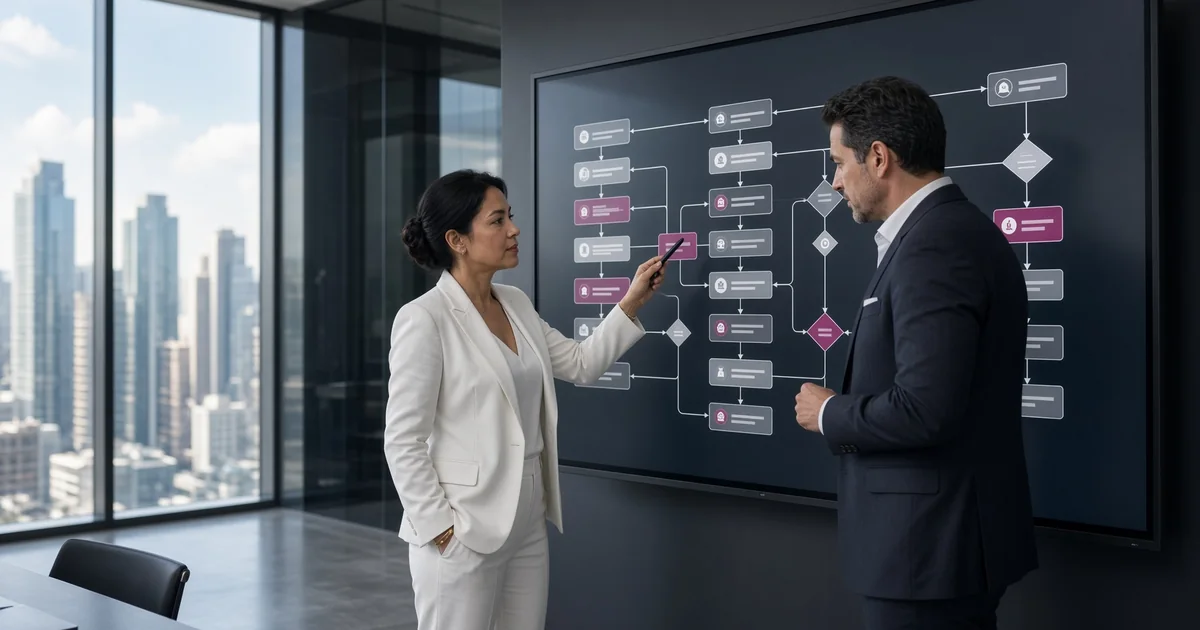
Imagen generada con IA · AI-generated image
Direct answer: a good daily brief fits on one screen and answers four questions before leadership opens the inbox: what got done while nobody was watching, what is waiting on a decision, what fell outside the playbook, and how the numbers moved against the goal. Everything else lives in the log, one click away, for whoever needs it.
When a company starts working with digital employees, the question changes fast. It is no longer "does this work?" but "how do I know what happened without checking everything by hand?" The answer is not a longer report. It is a shorter, better-designed brief.
The underlying problem is not a lack of information. It is too much coordination. Asana's Anatomy of Work Index, which surveyed more than 10,000 knowledge workers, found that 60% of their time goes to "work about work": chasing the status of tasks, searching for information, switching between apps and reshuffling priorities.
A report that lists activity ("214 messages answered," "37 forms processed") adds to that noise. It shows that things moved, but it does not tell leadership what to do about it. A number without context forces someone to open another tool to understand it, and that is exactly the time the report was supposed to save.
A useful brief does the opposite: it filters. Routine work gets one line. Anything that needs human judgment rises to the top, with the context already assembled.
1. What got done. One line per area: customer service, collections, onboarding, reporting. Volume and status, with a link to the full log. If leadership wants to audit, the detail is there; if not, it stays out of the way.
2. What is waiting on you. This is the most important block. Each item carries three things: what needs deciding, the prepared recommendation and when the answer is needed. A decision without a deadline becomes a decision nobody makes.
3. Exceptions. What fell outside the playbook: a case the digital employee was not authorized to resolve, a figure that did not reconcile, an unhappy customer. For each one, the brief says where it was escalated, which person is accountable for it and where it stands.
4. The numbers against the goal. A few indicators, always the same ones, compared with the target and with last week. Consistency matters more than volume: if the metrics change every day, nobody learns to read them.
Picture a mid-sized wealth management firm. Overnight, the onboarding digital employee prepares the account-opening requests that came in through the website form: it checks that the documents are complete, compares the data against the rules in the playbook and leaves each file ready for the compliance team.
The 7:00 a.m. brief does not say "requests were processed." It says something like this: last night's requests are prepared for review; two are on hold because an ID document is missing, and the client has already been asked for it; one was escalated to the compliance officer because the beneficial ownership structure does not match what was declared, and she has it on her list for today. And one decision for leadership: approve or reject the new Spanish welcome message, with the team's recommendation and a Thursday deadline.
That brief takes a minute to read. Nobody had to chase anybody to find out where the work stood.
What leadership needs to see is not that everything went well, but where it did not and who is handling it. That is why the exceptions block should never be buried at the bottom or reduced to a percentage.
NIST's AI Risk Management Framework (AI RMF 1.0) frames this as governance: it calls for post-deployment monitoring plans that include override and incident response mechanisms (MANAGE 4.1), and for incidents and errors to be communicated to relevant actors through documented processes (MANAGE 4.3). A daily brief is a practical way to live that idea every day: each exception stays visible, with the name of the person handling it.
At UGUETO AI, the daily brief is one of the three parts of the command center, alongside the approval queue and the results board. The logic is the same in all three: the digital employee does the work, and a person makes the calls that require judgment.
You do not need new technology to take the first step. Run this exercise with your team:
If the brief you design does not fit on one screen, it is still measuring activity instead of decisions. That is the same work UGUETO AI does during the mapping week: turning what leadership needs to know into written rules a digital employee can follow every morning.
It is a short summary that arrives every morning and answers four questions: what got done, what is waiting on a leadership decision, which exceptions came up and how the numbers are tracking against the goal.
An activity report counts motion. A brief filters: it sums up routine work in one line and puts anything that needs human judgment at the top, with context, a recommendation and a deadline.
What happened, where it was escalated, which person is accountable for it and where it stands. An exception without a named person responsible is a loose end nobody will close.
Few, and always the same ones, ideally no more than five, compared with the target and with last week. Consistency is what lets leadership learn to read them.
Servicios
What a digital employee's playbook is, the six parts it cannot skip, who should write it and how it stays current with every human correction.
Nov 18, 2026 · 5 min

Servicios
Learn what a digital employee is, how it works from your company playbook, and why it always needs boundaries and human judgment.
Nov 18, 2026 · 2 min

Servicios
Compare digital employees, chatbots, and copilots by scope, oversight, integration, and the criteria your business should use to choose with confidence.
Nov 17, 2026 · 5 min